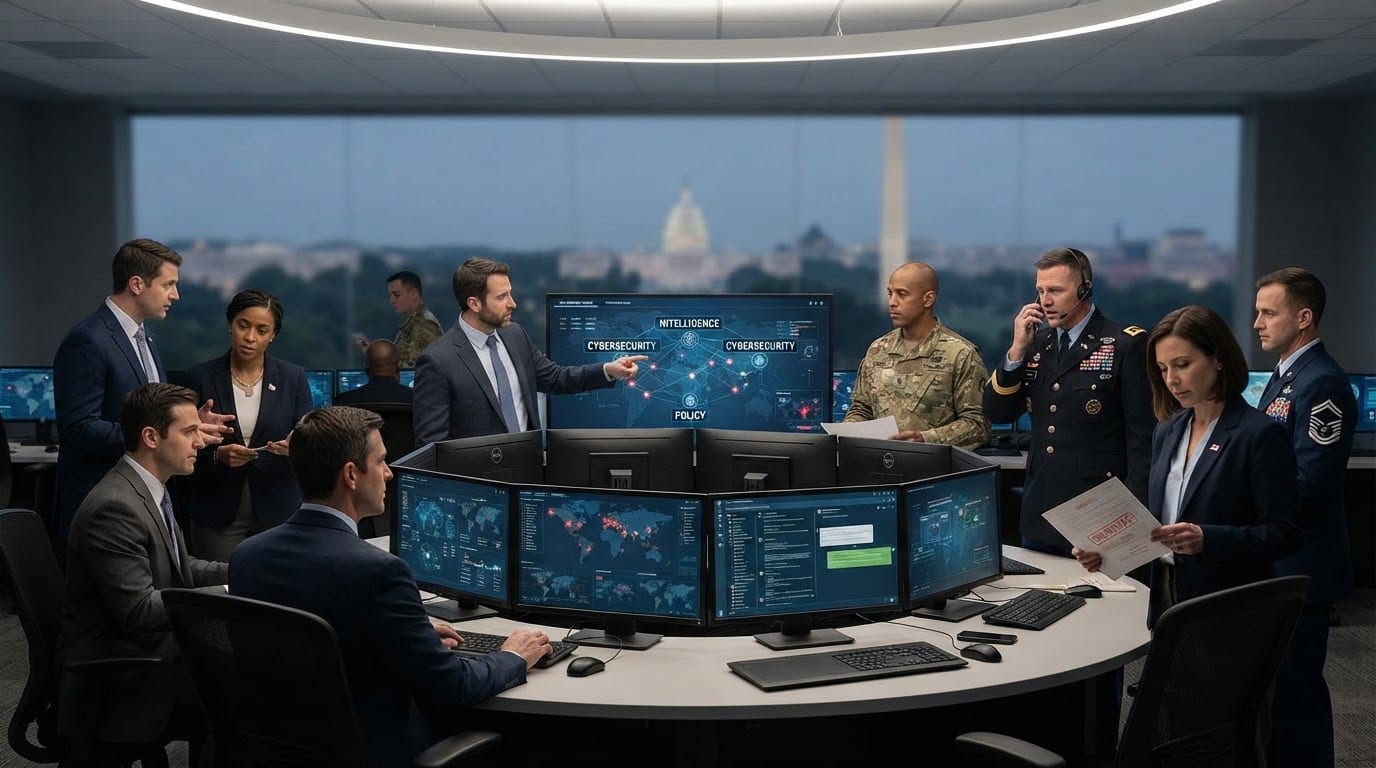
Few public policy areas involve as many agencies, legal authorities, and competing priorities as national security. When a foreign government probes a power grid, a researcher’s laboratory is targeted for stolen data, or a military base faces a credible threat, responsibility is divided among organizations that answer to different parts of the government. Understanding that structure helps explain who collects information, who makes decisions, and who checks their work.
For a general overview of how these pieces fit together, readers can consult Nationalsecurityus alongside the primary sources referenced in this article, including statutes, executive orders, and annual public reports. Most of the system’s foundations are documented in law, even when the details of specific operations are not.
Start with the scope of the subject itself. In everyday conversation, national security often means defending the country from attack. In government practice, it covers considerably more: military deterrence, intelligence collection, diplomacy, homeland protection, and safeguards for the economy and emerging technology. These areas overlap constantly. A cyberattack on a water utility, for example, may involve the Federal Bureau of Investigation for the criminal case, the Cybersecurity and Infrastructure Security Agency for defense of the utility, the National Security Agency for technical analysis of foreign actors, and the State Department for diplomatic response. Each agency has a defined role, but the incident does not respect those boundaries.
Readers should also set realistic expectations about what is public. Congress publishes funding and authorization laws, and the Director of National Intelligence releases an unclassified annual threat assessment. Court rulings on surveillance, inspector general reports, and declassified documents add further detail. Operational methods, sources, and many budget line items remain classified. The gap between these two categories is central to nearly every debate about accountability, discussed later in this article.
Inside the Intelligence Community
The Intelligence Community is a federation of 18 agencies and offices, coordinated by the Office of the Director of National Intelligence (ODNI), which was created by the Intelligence Reform and Terrorism Prevention Act of 2004. Its members include both independent agencies and intelligence components within departments such as Defense, Justice, Homeland Security, Energy, and Treasury.
The National Security Agency (NSA) is the most frequently misunderstood member. It is a Department of Defense combat support agency with two principal missions. The first is signals intelligence: collecting, processing, and analyzing foreign communications and electronic signals, under legal authorities such as Executive Order 12333 and Section 702 of the Foreign Intelligence Surveillance Act. The second is cybersecurity and information assurance, which involves protecting national security systems and advising government and critical infrastructure operators on defending their networks. The NSA does not conduct domestic law enforcement, and its authority to collect information on U.S. persons is restricted by statute and court oversight.
Other agencies divide responsibilities along different lines:
- Central Intelligence Agency (CIA): Collects foreign intelligence, largely through human sources, and conducts covert action when directed by the president. It has no domestic police powers.
- Federal Bureau of Investigation (FBI): Serves as the lead domestic intelligence and law enforcement agency, operating under the Department of Justice. Its counterintelligence and counterterrorism work inside the United States is subject to the Attorney General’s guidelines.
- Department of Homeland Security (DHS): Established by the Homeland Security Act of 2002, it coordinates border security, transportation security, and critical infrastructure protection. Its Cybersecurity and Infrastructure Security Agency handles civilian federal and private-sector cyber defense.
- Defense Intelligence Agency (DIA): Provides military intelligence to the Secretary of Defense, the Joint Chiefs of Staff, and combatant commands, and manages much of the Defense Intelligence Enterprise.
A useful way to compare these organizations is by mission type rather than alphabetically. Foreign human intelligence falls mainly to the CIA. Foreign signals intelligence and defensive cyber expertise sit with the NSA. Military intelligence is led by the DIA and the service intelligence commands. Domestic law enforcement and counterintelligence belong to the FBI. Protection of civilian networks and borders is assigned to DHS.
Information sharing has grown since the September 11 attacks, when the lack of coordination was widely criticized. Joint task forces, fusion centers, and shared databases now connect agencies. Legal limits still separate roles, however. The CIA’s foreign focus, the FBI’s domestic law enforcement mandate, and the NSA’s restrictions on collecting information about Americans are deliberate features, not accidental gaps.
Who Directs Security Policy and Decisions
The National Security Act of 1947 created the National Security Council (NSC), the White House body that coordinates security policy among departments. The council is chaired by the president and typically includes the Vice President, the Secretaries of State, Defense, and the Treasury, and the Director of National Intelligence, with the Chairman of the Joint Chiefs of Staff and the Director of the CIA as statutory advisers.
The National Security Advisor leads the NSC staff. The office’s function is to manage the policy process, prepare decision papers, organize interagency meetings, and ensure that options reach the president with clear tradeoffs. The adviser is not confirmed by the Senate and does not command any operational agency, which means the office’s influence depends largely on its coordinating role and access to the president.
Cabinet departments implement policy and provide the expertise that the council relies on. The State Department conducts diplomacy and sanctions policy. The Defense Department manages military operations and force posture. Treasury administers financial sanctions through the Office of Foreign Assets Control. Commerce, through the Bureau of Industry and Security, controls export of sensitive technologies. Each department holds authority granted by statute, and decisions requiring legal approval, such as certain covert actions, must be formally notified to Congress.
Congress shapes the system in three main ways:
- Funding: Appropriations committees decide how money flows to defense and intelligence programs. Much of the intelligence budget is classified, although the aggregate top-line figure is disclosed each year.
- Authorization: Armed Services committees and the Senate and House Intelligence committees set the legal framework for programs, including the authorities that govern surveillance and covert operations.
- Confirmation: The Senate confirms the Secretaries of cabinet departments, the Director of National Intelligence, the CIA Director, and many senior military and security officials.
Responsibility is clearest at the top and most diffuse in the middle. The president sets strategy and holds ultimate constitutional authority. Department heads answer for their agencies’ performance. Agency directors manage operations within legal limits. Oversight bodies review compliance afterward. When an action goes wrong, accountability usually traces through this chain, though the classified nature of many decisions can make the trail difficult for the public to follow.
Threats the Country Is Tracking Now
Officials organize national security threats into durable categories, which allows assessments to remain useful even as headlines shift. The ODNI’s annual threat assessment, along with reports from the Departments of Defense and Homeland Security, typically covers the following areas:
- State-based military competition: Russia and China are described as the primary strategic competitors, with capabilities in nuclear weapons, space systems, and advanced missiles. Iran and North Korea are assessed as threats to regional stability and to U.S. partners.
- Cyber intrusions: State-sponsored and criminal actors target government networks, defense contractors, healthcare providers, and critical infrastructure such as electric grids and pipelines. Ransomware attacks on local governments and hospitals are a frequent concern.
- Terrorism: Both foreign terrorist organizations and domestic violent extremists are monitored. Assessments emphasize that threats can emerge quickly from individuals who are not part of an organized group.
- Weapons proliferation: Efforts to acquire nuclear, chemical, biological, and advanced conventional weapons are tracked through export controls, sanctions, and international inspection regimes.
- Foreign influence operations: Governments use social media, state media, and covert funding to shape public opinion and political outcomes. Detection and attribution are difficult, and responses must balance security against free expression.
Economic security has become a distinct category. Dependence on foreign supply chains for semiconductors, pharmaceuticals, and rare earth minerals creates vulnerabilities that officials now treat as security issues. The Committee on Foreign Investment in the United States (CFIUS) reviews certain foreign acquisitions of American companies, and export controls restrict transfers of sensitive research and technology. Universities and research laboratories have become points of focus because they produce valuable intellectual property and often operate on open networks.
Threat assessments are produced through a structured process. Analysts draw on intelligence reporting, open-source material, and technical data, then evaluate that information against confidence standards. Estimates are reviewed through interagency coordination, and dissenting views are often recorded. Emphasis shifts over time because of changes in adversary capabilities, the emergence of new technologies, and political priorities. A threat that receives intense attention in one administration may be treated as a long-term trend in another, which is why readers should compare assessments across years rather than relying on a single report.
Oversight, Transparency, and Where Public Information Ends
Intelligence and security agencies operate under several layers of oversight. The congressional intelligence committees, the Senate Select Committee on Intelligence and the House Permanent Select Committee on Intelligence, receive classified briefings and conduct investigations. Inspectors general, established under the Inspector General Act of 1978 and found in most major agencies, audit programs, investigate misconduct, and publish reports. The Privacy and Civil Liberties Oversight Board reviews counterterrorism programs for their effect on privacy and civil liberties.
Courts provide another check. The Foreign Intelligence Surveillance Court reviews applications for electronic surveillance under FISA and approves certain collection programs. Its proceedings are largely classified, and critics argue that its one-sided format limits adversarial testing of government claims. Reforms enacted in 2015 and later addressed some of these concerns, though debate continues.
The public has several tools for learning more:
- Declassification review: Executive Order 13526 governs classification and sets procedures for declassifying records after set periods. The Interagency Security Classification Appeals Panel hears challenges to classification decisions.
- Freedom of Information Act (FOIA) requests: Requests to agencies can produce records, though exemptions for national security and intelligence sources frequently result in heavy redaction or denial. Appeals and litigation are common.
- Published reports: Inspector general reports, the annual threat assessment, congressional hearing transcripts, and court opinions, when released, provide authoritative public material.
The tension between secrecy and accountability is long-standing. Supporters of broad classification argue that intelligence sources and methods lose value once exposed, that adversaries can exploit disclosures, and that protecting operational details is necessary for effective collection. Critics respond that excessive secrecy prevents voters from judging whether programs are lawful or effective, that over-classification hides embarrassing errors, and that oversight bodies cannot substitute for public scrutiny. Both positions have merit, and most policy debates involve finding a workable middle ground.
Evaluating claims about security agencies requires discipline. Start with primary records: statutes, executive orders, official reports, and court opinions. Compare official statements with independent analysis from research organizations and academic experts, noting their methods and funding sources. Distinguish between documented facts, reasonable inferences, and unverified assertions. When an account relies on anonymous sourcing, consider whether other records corroborate it. Careful readers who follow these steps can navigate a system that is partly public and partly hidden with a clearer sense of what the evidence actually shows.
